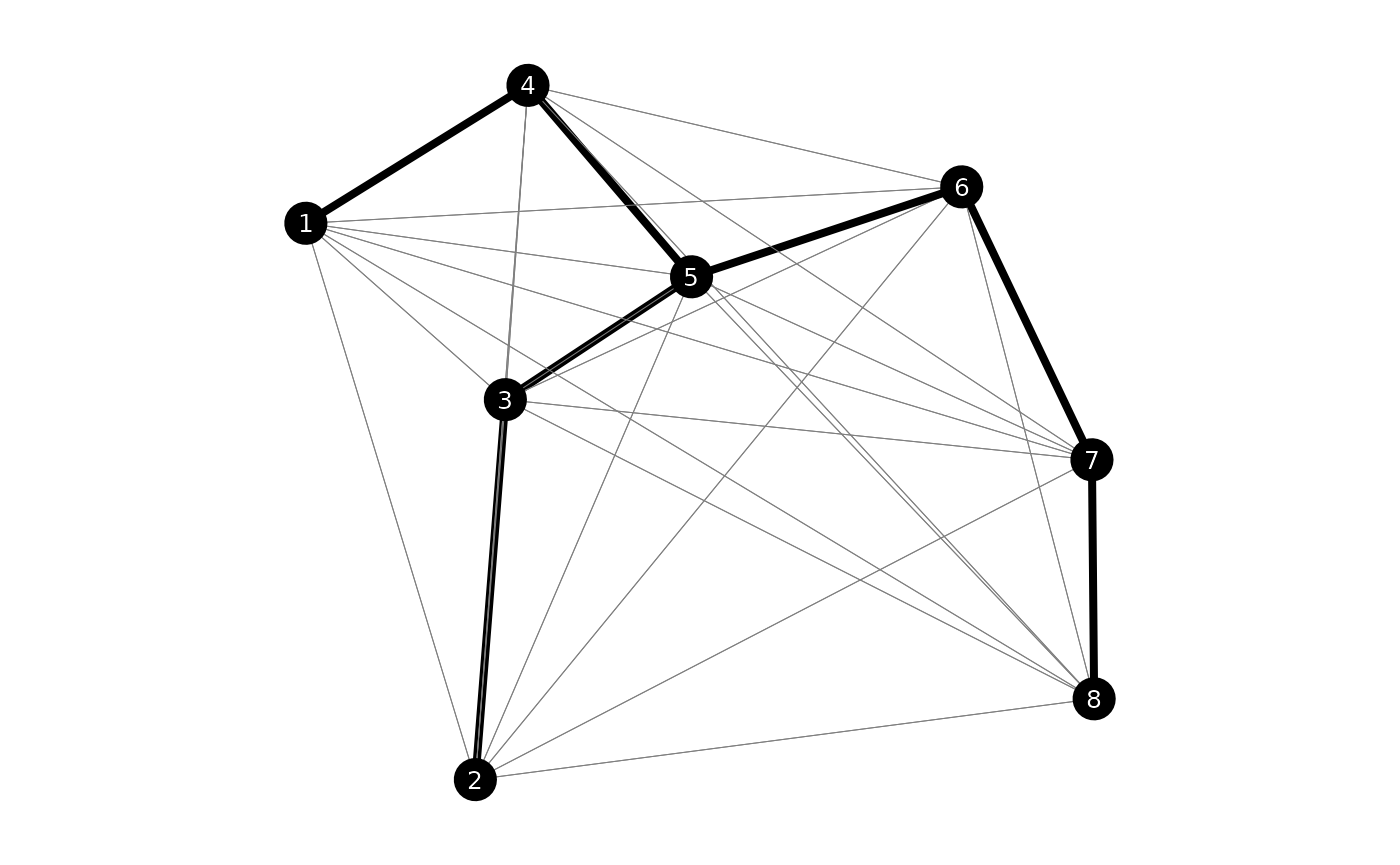
This vignette focuses on all sorts of problems relating to graphs. We will create a complete graph and an incomplete but connected graph.
library(lpsugar)
library(ROI)
#> ROI: R Optimization Infrastructure
#> Registered solver plugins: nlminb, highs.
#> Default solver: auto.
library(dplyr, warn.conflicts = FALSE)
set.seed(125)
n <- 8

nodes <- tibble(
    x = runif(n),
    y = runif(n)
) |>
    arrange(x) |>
    mutate(ind = 1:n)

edges_complete <- expand.grid(from = nodes$ind, to = nodes$ind) |>
    as_tibble() |>
    filter(from != to) |>
    mutate(
        x1 = nodes$x[from],
        x2 = nodes$x[to],
        y1 = nodes$y[from],
        y2 = nodes$y[to],
        dx = x1 - x2,
        dy = y1 - y2,
        cost = sqrt(dx^2 + dy^2),
        dx = NULL, dy = NULL,
        active = FALSE,
    )

edges_connected <- edges_complete |>
    slice_sample(prop = 0.25, weight_by = 1/cost)

plot_graph(edges_complete)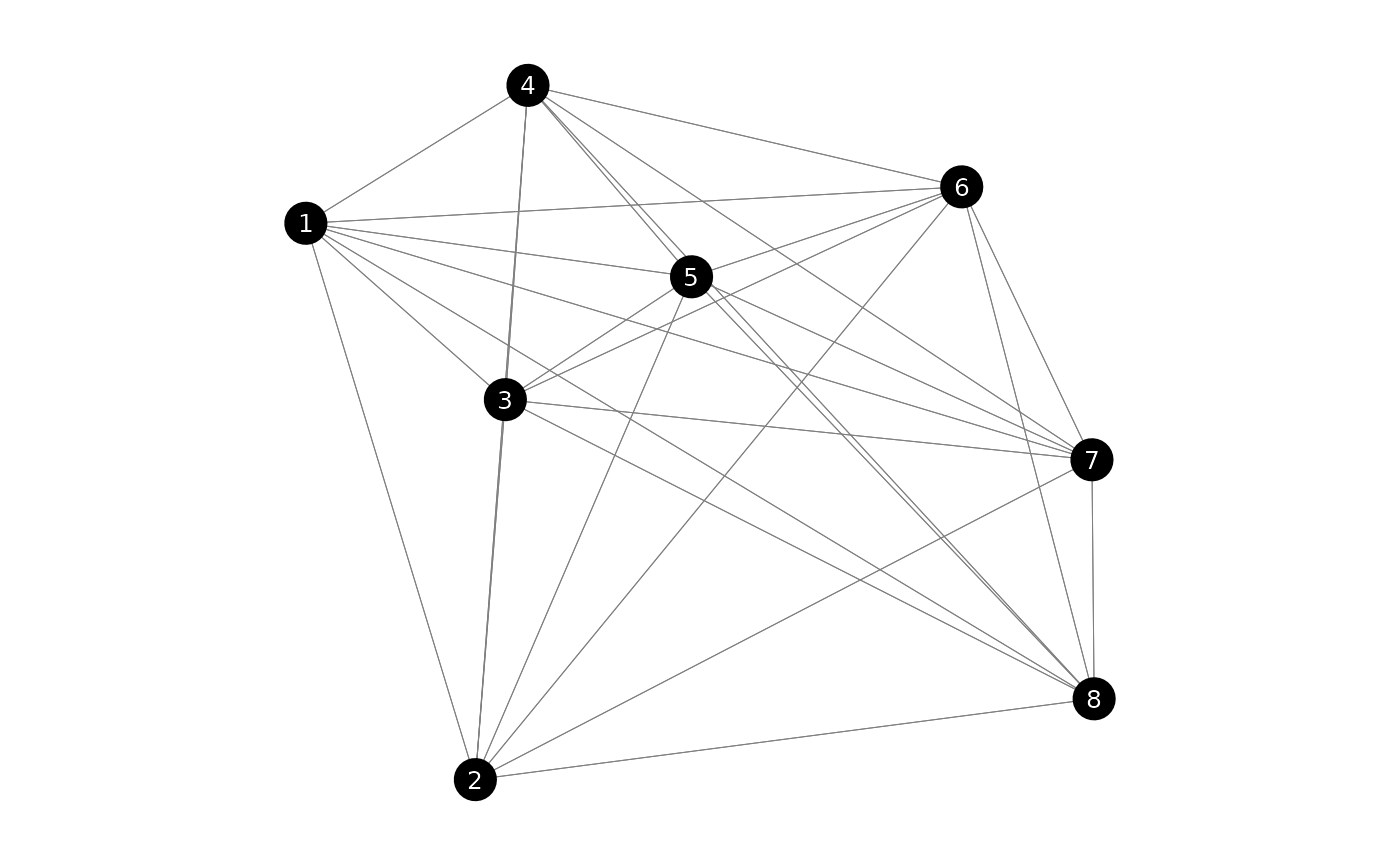
plot_graph(edges_connected)
Minimum Spanning Tree
Complete graph
We start by creating the cost matrix. It’s a symetrical square matrix indicating the distance from each to each node.
We will solve it as a flow problem. We choose an arbitrary root node and make it send units of flow, where is the number of nodes. Each node demands 1 unit.
Our decision variable flow[i, j] indicates how many
units flow from node i to j. Since
flow[i, i] will be zero, we can fix an upper bound of 0 for
the diagonal of flow.
upper_bound <- matrix(Inf, nrow = n, ncol = n)
diag(upper_bound) <- 0

msp <- lp_problem() |>
    lp_variable(flow[nodes$ind, nodes$ind], lower = 0, upper = upper_bound)
# Alternatively, but slower
msp <- lp_problem() |>
    lp_variable(flow[nodes$ind, nodes$ind], lower = 0) |>
    lp_constraint(diag(flow) == 0)
The next step is to set our objective. But for this we will need an
auxiliary binary variable, telling us whether an edge has a flow. We
call this variable has_flow and define it as binary. Then
we connect it to our flow variable.
msp <- msp |>
    lp_variable(has_flow[nodes$ind, nodes$ind], binary = TRUE) |>
    lp_constraint(flow <= n * has_flow)
We can now set the objective.
msp <- msp |>
    lp_minimize(sum(cost * has_flow))
Now let’s restrict the flow of the rest of the nodes. Let’s choose the 1st node as our root. It will have a supply of units. Each other node will have a supply of and a demand of .
msp <- msp |>
    lp_constraint(
        root = sum(flow[1, ]) <= n,
        demand = for (i in nodes$ind)
            sum(flow[, i]) - sum(flow[i, ]) == 1
    )
The full code of the problem is this:
upper_bound <- matrix(Inf, nrow = n, ncol = n)
diag(upper_bound) <- 0

msp <- lp_problem() |>
    lp_variable(
        flow[nodes$ind, nodes$ind],
        lower = 0, upper = upper_bound
    ) |>
    lp_variable(
        has_flow[nodes$ind, nodes$ind],
        binary = TRUE
    ) |>
    lp_minimize(
        sum(cost * has_flow)
    ) |>
    lp_constraint(
        aux = flow <= n * has_flow,
        root = sum(flow[1, ]) <= n,
        demand = for (i in nodes$ind[-1])
            sum(flow[, i]) - sum(flow[i, ]) >= 1
    )
Let’s find the solution.
msp_solution <- lp_solve(msp)
msp_solution$objective
#> [1] 2.097602
msp_solution$variables$has_flow
#>          nodes$ind
#> nodes$ind 1 2 3 4 5 6 7 8
#>         1 0 0 0 1 0 0 0 0
#>         2 0 0 0 0 0 0 0 0
#>         3 0 1 0 0 0 0 0 0
#>         4 0 0 0 0 1 0 0 0
#>         5 0 0 1 0 0 1 0 0
#>         6 0 0 0 0 0 0 1 0
#>         7 0 0 0 0 0 0 0 1
#>         8 0 0 0 0 0 0 0 0